

Wall designs: more than just decoration
Wall design influences how people perceive, experience, and move within a space. Art in a room creates atmosphere, conveys identity, and develops an emotional connection between architecture and people.
Wall design fulfills far more than a decorative function. It can provide orientation, structure spaces, represent brand values, and create a creative atmosphere. Depending on the concept, it can be inspiring, communicative, attention-grabbing, or understated, thus actively supporting the effect of a room.
Especially in offices, hotels, medical practices, restaurants, or public institutions, individual design creates an environment with a distinctive character and high recognition value. Art thus becomes part of the spatial identity and sustainably shapes the perception of a place.
Implementation is possible both indoors and outdoors. Different surfaces such as walls, glass surfaces or facades can be individually designed and integrated into the concept.
Application areas
Offices and coworking spaces benefit from creative spatial concepts that foster inspiration, identity, and a pleasant working atmosphere. In medical practices, artistic design can have a calming effect and positively influence the perception of spaces.
Hotels and restaurants gain a distinctive character and a stronger emotional impact on guests and visitors through individual wall designs. Reception areas and meeting rooms can be designed to be both representative and to provide orientation and atmosphere.
Public institutions and cultural spaces also benefit from creative design elements that visually enhance spaces and intuitively appeal to people. Facades and courtyards create a lasting first impression from the outside, adding an artistic dimension to architecture.
Showrooms and retail spaces strategically use wall design to bring brand worlds to life and atmospherically showcase products. This creates spaces with high recognition value and a clear visual identity.


Materials and technology
A wide selection of materials and artistic techniques is available for every wall design. Depending on the project, tape art, graffiti, installation art, or a combination of different styles can be used. The choice of technique always depends on the spatial conditions, the desired effect, and the requirements of the specific project.
Not every technique is suitable for every location. For example, indoors, where spray paint cannot be used, materials that can be applied without overspray are employed. Glass surfaces, on the other hand, can be decorated particularly effectively with tape art, as this technique is precise and can be removed without leaving any residue.
This results in an individual solution for each project, combining design quality with the technical possibilities of the respective location.
Projects

Digital Disguise
Tape art not only protected privacy here, but also made ]init['s digital orientation visible. A dense network of geometric shapes served as a visual barrier.

Railroad Tycoon
A floor-spanning tape art concept gave the DB Netz office building both orientation and identity. Seventeen walls across seven floors followed a common visual language of railway networks and color coding.

Seeing Beyond
Precision and humanity merged in the tape art-style trade fair booth design for ZEISS to create a memorable brand experience. A stylized eye made of fine technical lines connected highly advanced diagnostic technology with the people behind it.
View the Seeing Beyond project

Ballet of Time
A permanent tape art facade made the site's history visible for Spar Nord and remained in place long after the festival. Two dancing figures connected the past and future of the location.
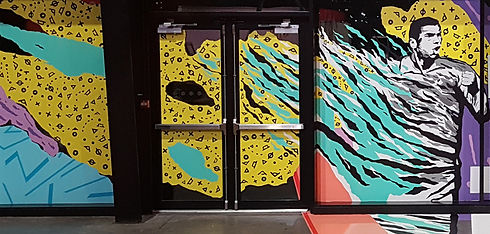
Out of the Game
A glass facade on the Thames became a stage for the launch of FIFA 20, where the digital and real worlds merged. An anamorphic composition of floor and window allowed the game world and the skyline to blend seamlessly.

Rolling Religion
Skate and BMX culture were given an almost sacred visual language in the wall design for the Berlin skate hall, creating a lasting impression. The hall's industrial windows were transformed into modern church windows with dancing figures through tape art and graffiti.
View the Rolling Religion project

Sonorous
The energy of a conductor was transformed into a tape art installation on the glass facade at the entrance of the Berlin Philharmonie, making every visit special. Overlapping, repeating lines translated the music into a graphic visual language.

Local View
A Berlin landmark became the eye-catcher for a pop-up store in Alexa Berlin. The TV tower appeared as a see-through tape art motif on the shop window.
View project Local View
Spaces with identity.
Each wall design is individually developed for its location, its use, and its architectural features. The focus is on tailor-made design concepts that combine architecture, brand identity, and spatial impact.
This results in visual solutions that provide orientation, enhance spaces and give places a distinctive identity.

Let's talk about your project.

I look forward to your inquiry regarding wall designs, artistic event formats, workshops or individual art projects.
Direct contact
Michael Weingart
Email: info@mischka.art
Telephone: +49 157 86775414
Contact hours
Mon - Fri
10:00 – 18:00

